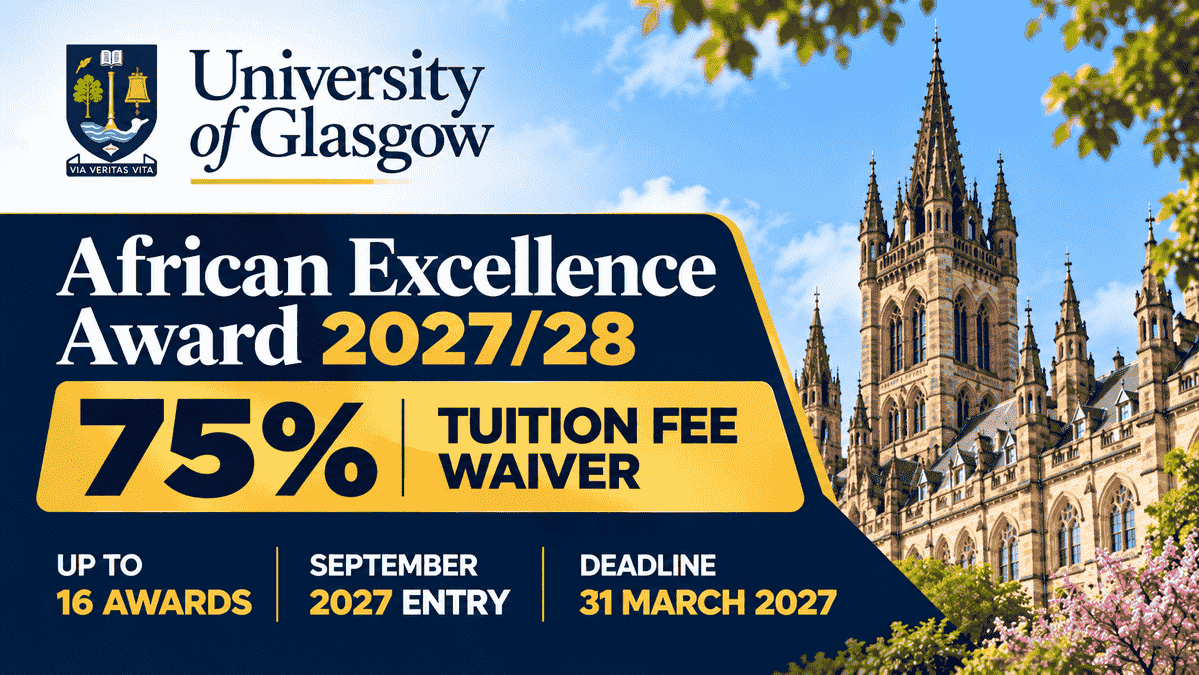
The University of Glasgow African Excellence Award 2027/28 offers up to 16 African students a 75% tuition-fee waiver for an eligible one-year taught master’s programme starting in September 2027. The award supports academically excellent students who want to develop their skills and use their postgraduate education to contribute to their communities.
To qualify, applicants must achieve grades equivalent to a UK first-class honours degree, hold a passport from an eligible African country, live in Africa and meet the university’s international fee-status requirements. You can submit a scholarship application before receiving a course offer, but you must hold an eligible offer to be considered for an interview.
The deadline is 31 March 2027 at 11:59 p.m. UK time. This guide explains the award’s value, eligibility rules, application process, key dates and the costs you must cover yourself.
Last verified: 12 October 2026.
University of Glasgow African Excellence Award 2027/28: Overview
| Detail | Information |
|---|---|
| Host university | University of Glasgow, Scotland, United Kingdom |
| Scholarship value | 75% tuition-fee waiver |
| Number of awards | Up to 16 |
| Entry year | September 2027 |
| Study level | One-year, full-time postgraduate taught master’s |
| Eligible applicants | International students domiciled in eligible African countries who hold an eligible country’s passport |
| Academic requirement | Grades equivalent to UK first-class honours |
| Application deadline | 31 March 2027, 11:59 p.m. UK time |
| Shortlist notification | By 7 May 2027 |
| Separate scholarship application | Required |
| Living expenses covered | No |
The award is available across disciplines, provided the programme meets the university’s eligibility conditions. Postgraduate diplomas and postgraduate certificates do not qualify.
The university offers up to 16 awards, so meeting the published eligibility requirements does not guarantee selection.
What Does the 75% Tuition-Fee Waiver Cover?
The scholarship reduces eligible tuition fees by 75%. You must pay the remaining 25%, as well as your living expenses and other costs associated with studying in the UK.
The university publishes the following examples based on average international tuition fees for its colleges.
| University college | Example international tuition fee | Example 75% waiver | Remaining 25% |
|---|---|---|---|
| Arts and Humanities | £27,390 | £20,542.50 | £6,847.50 |
| Medical, Veterinary and Life Sciences (MVLS) | £33,708 | £25,281 | £8,427 |
| Science and Engineering | £34,815 | £26,111.25 | £8,703.75 |
| Social Sciences | £28,275 | £21,206.25 | £7,068.75 |
| Adam Smith Business School | £34,815 | £26,111.25 | £8,703.75 |
These figures illustrate the potential discount. They do not guarantee the fee or scholarship amount for an individual course. Your actual award depends on the tuition fee stated in your offer letter.
For example, if your chosen master’s programme costs £30,000, a 75% waiver would reduce the fee by £22,500. You would still owe £7,500 in tuition fees.
The award is not a fully funded scholarship. It does not cover your remaining tuition fees or living expenses. You should budget separately for accommodation, food, transport, travel and other costs.
The university also requires recipients to meet the applicable UKVI living-cost financial requirement. Check the official government guidance for the current financial requirements rather than relying on an amount quoted in an older scholarship article.
Before accepting an offer, calculate your remaining tuition fee using the actual course fee and assess whether you can cover the balance and living costs.
Who Is Eligible for the African Excellence Award?
You must meet the university’s academic, nationality, residency, fee-status and programme requirements. Meeting one condition does not remove the need to satisfy the others.
1. You must hold an eligible African passport and live in Africa
The university requires applicants to be domiciled in Africa and hold a passport from one of its eligible countries.
The eligible countries are:
- Algeria, Angola, Benin, Botswana, Burkina Faso and Burundi
- Cameroon, Cape Verde, Central African Republic, Chad, Comoros and Congo
- Democratic Republic of the Congo, Côte d’Ivoire, Djibouti, Egypt, Equatorial Guinea and Eritrea
- Eswatini, Ethiopia, Gabon, The Gambia, Ghana, Guinea and Guinea-Bissau
- Kenya, Lesotho, Liberia, Libya, Madagascar, Malawi and Mali
- Mauritania, Mauritius, Morocco, Mozambique, Namibia, Niger and Nigeria
- Rwanda, São Tomé and Príncipe, Senegal, Seychelles, Sierra Leone and Somalia
- South Africa, South Sudan, Sudan, Tanzania, Togo, Tunisia, Uganda, Zambia and Zimbabwe
Nigerian applicants can qualify because Nigeria appears on the list. However, they must also meet the residency, academic, programme and fee-status requirements.
African ancestry or citizenship alone is not enough if you do not satisfy the university’s requirement to be domiciled in Africa and hold an eligible passport.
2. You must demonstrate academic excellence
Applicants must achieve grades equivalent to a UK first-class honours degree.
Do not assume that any bachelor’s degree automatically meets this standard. If your university uses a different grading system, check the University of Glasgow’s admissions guidance and ask the university to clarify your eligibility if necessary.
Your academic record must meet the required standard; a strong career plan does not replace this academic condition.
3. You must choose an eligible master’s programme
The award covers eligible one-year, full-time postgraduate taught master’s programmes starting in September 2027.
Postgraduate diplomas and postgraduate certificates are excluded. The university also identifies two specific exceptions:
- Book and Paper Conservation MPhil
- Textile Conservation MPhil
For these two programmes, the award covers one year of study only.
Before applying, check the course’s structure, entry requirements, tuition fees and admission deadline. Do not assume that every postgraduate programme at Glasgow qualifies simply because it leads to a postgraduate qualification.
4. You must have international fee status
The university requires recipients to hold international fee status.
If you are unsure how Glasgow will classify your fees, contact the university for clarification. Do not rely on nationality alone to determine your fee classification.
5. You must present a clear career or development plan
The scholarship application must explain how your proposed master’s degree will support your career or development plans.
The university wants to support students who intend to develop their knowledge and skills and contribute positively to their communities. Your explanation should therefore connect your chosen course with a credible future goal.
You can organise your response around four questions:
- What do you want to achieve? Identify a specific professional or development goal.
- Why do you need this master’s degree? Explain which knowledge or skills you want to gain from the programme.
- How will you use what you learn? Describe where or how you intend to apply those skills.
- What contribution do you hope to make? Explain the realistic outcome you want to support in your community, profession or field.
For example, rather than saying only that you want to help your country develop, explain the issue you hope to address, how the programme relates to it and what you plan to do after graduation.
This framework is a practical way to organise your application. It is not an official scoring rubric published by the university.
How to Apply for the University of Glasgow African Excellence Award
The award requires a separate scholarship application. Applying for admission to a master’s programme does not automatically submit your scholarship application.
Step 1: Choose your master’s programme
Find a suitable one-year, full-time postgraduate taught master’s programme beginning in September 2027.
Check the course’s admission requirements, tuition fees, structure and application deadline. Choose a programme that supports your academic interests and career plans, because you will need to explain this connection in your scholarship application.
Step 2: Check your eligibility and prepare
Before submitting your applications, confirm that you:
- Hold a passport from an eligible African country.
- Are domiciled in Africa.
- Meet the academic requirement equivalent to UK first-class honours.
- Qualify for international fee status.
- Intend to enrol in an eligible programme.
- Can explain how the degree will support your career or development plan.
Also review the course admission requirements and estimate the tuition balance you would need to pay after the waiver.
Use the university’s current scholarship application instructions to confirm what information or supporting material the scholarship form requires. Do not assume that documents required for course admission automatically satisfy the scholarship application.
Prepare early where possible. Academic records, course applications and other supporting materials may take time to organise, but follow the actual instructions for each application rather than assuming that every document is mandatory for the scholarship.
Step 3: Submit the scholarship application
Complete the University of Glasgow African Excellence Award application through the official scholarship page.
You do not need a course offer to submit the scholarship application. However, you must hold an offer for an eligible one-year postgraduate taught master’s programme to be considered for an interview.
This distinction matters: the scholarship application and the admission application are separate processes.
Step 4: Apply for Admission Alongside Your Scholarship Application
Submit your application for admission to the eligible master’s programme alongside your scholarship application, following the course’s own requirements and deadline. You do not need to wait for a scholarship decision before applying for admission. However, you must hold an eligible course offer to be considered for a scholarship interview.
Because the scholarship application does not replace your course application, plan both processes together. Waiting too long to apply for admission could prevent you from securing an offer in time for interview consideration.
The scholarship deadline does not automatically replace the admission deadline for your chosen course. Allow enough time for the university to assess your application.
Step 5: Prepare for a possible interview
The university says it will contact shortlisted applicants by 7 May 2027.
The published scholarship information does not provide a complete interview format or a guaranteed list of questions. Rather than relying on speculative predictions, prepare to explain:
- Your academic achievements and relevant experience.
- Why you chose your particular master’s programme.
- How the degree supports your career or development plan.
- How you intend to use your skills to contribute to your community or field.
- How you plan to fund the remaining tuition fees and living expenses.
Use specific examples from your academic, professional or community experience where relevant.
Important Dates for 2027/28 Applicants
| Event | Date |
|---|---|
| Scholarship application deadline | 31 March 2027, 11:59 p.m. UK time |
| Shortlisted applicants contacted | By 7 May 2027 |
| Expected programme start | September 2027 |
The 31 March 2027 deadline applies to the scholarship application. Your intended master’s programme may have a different admission deadline.
Start checking course requirements early and allow enough time for the university to assess your admission application. Remember that you need an offer before you can be considered for an interview.
Can You Combine the Award with Another Scholarship?
The University of Glasgow states that its scholarships and discounts generally cannot be combined with one another or with external sponsorship discounts. The published exception is the university’s Alumni Discount.
If the university offers you more than one scholarship, it says it will remove the lower-value award from your account.
If you receive another scholarship or external funding offer, check the conditions before assuming that you can combine the benefits. Contact the university if you need clarification about how the rules apply to your circumstances.
Frequently Asked Questions
How many students will receive the Glasgow African Excellence Award?
The University of Glasgow offers up to 16 African Excellence Awards for eligible international students starting a qualifying master’s programme in the 2027/28 academic session.
Can Nigerian students apply?
Yes. Nigeria is on the eligible-country list. Nigerian applicants must also be domiciled in Africa, hold an eligible passport, meet the academic standard and satisfy the programme and international fee-status requirements.
Do I need a university offer before applying?
No. You can submit the scholarship application before receiving a course offer. However, you must hold an offer for an eligible master’s programme to be considered for an interview.
What is the application deadline?
The deadline is 11:59 p.m. UK time on 31 March 2027.
Does the scholarship cover living expenses?
No. The award reduces eligible tuition fees by 75%. Recipients must fund the remaining tuition fees and living expenses themselves and meet the applicable UKVI financial requirement.
Can postgraduate diploma or certificate students apply?
No. Postgraduate diplomas and postgraduate certificates are excluded. The award covers eligible one-year, full-time postgraduate taught master’s programmes, subject to the university’s stated conditions and the specific MPhil exceptions.
Final Thoughts
The University of Glasgow African Excellence Award 2027/28 offers up to 16 African students a substantial tuition discount for an eligible one-year taught master’s degree. However, the award does not remove the need to meet a high academic standard, develop a credible career or development plan and arrange funding for the remaining tuition fees and living costs.
Start by confirming your eligibility and selecting a qualifying programme. Prepare your scholarship application and course application in parallel, leaving enough time to secure an offer before interview consideration.
Submit the scholarship application by 31 March 2027 and check the university’s official scholarship page for the latest instructions before applying.