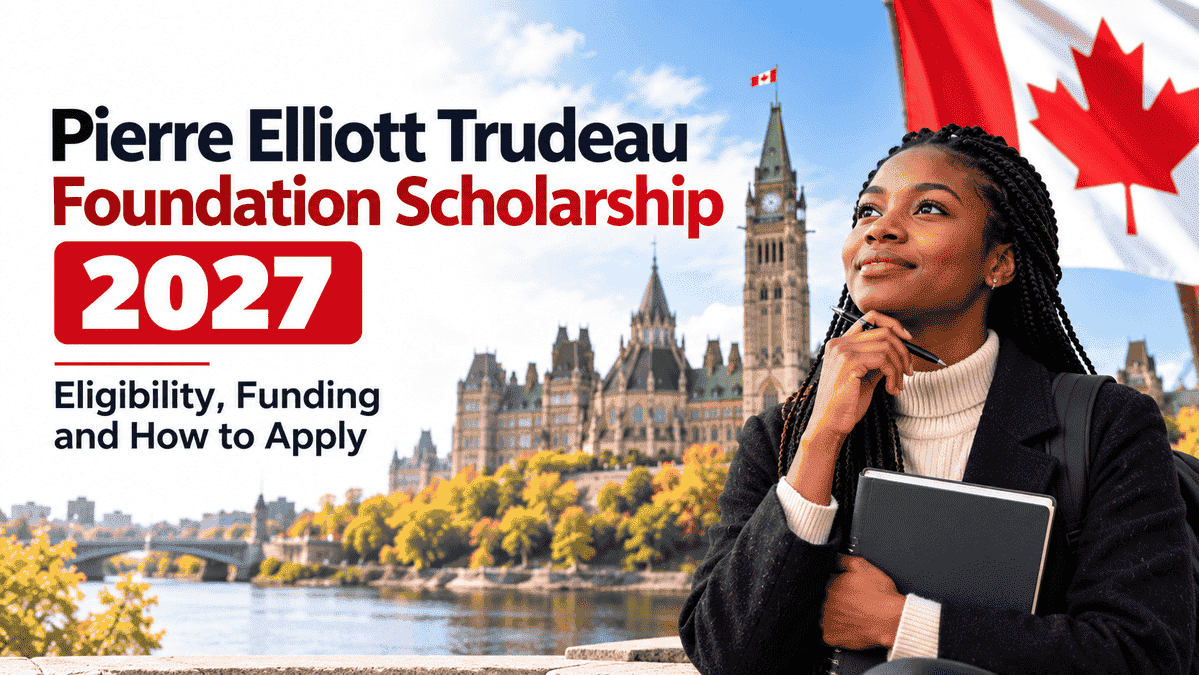
The Pierre Elliott Trudeau Foundation Scholarship 2027 offers doctoral researchers up to CAD $210,000 over three years, alongside mentorship, interdisciplinary learning and opportunities to connect academic research with public life.
However, the scholarship is not suitable for every PhD student. Applicants must meet specific requirements concerning their doctoral year, citizenship and university location. Their research must also align with the Foundation’s mission, and their applications should demonstrate academic excellence and a commitment to contributing beyond academia.
The 2027 competition introduced a two-stage application process. The deadline to request eligibility confirmation was October 2, 2026, and that stage has closed. The later deadlines apply only to candidates whose eligibility the Foundation confirmed.
This guide explains the funding, eligibility requirements, selection criteria and application process, helping prospective applicants assess whether the opportunity suits their research and academic profile.
Pierre Elliott Trudeau Foundation Scholarship 2027 at a Glance
| Scholarship detail | Information |
|---|---|
| Host organisation | Pierre Elliott Trudeau Foundation |
| Study level | PhD / doctoral studies |
| Duration | Three years |
| Maximum annual funding | CAD $70,000 |
| Maximum three-year value | CAD $210,000 |
| Research focus | Humanities and social sciences, broadly defined |
| Eligible applicants | Canadian students studying in Canada or abroad, and international students enrolled at Canadian universities |
| Doctoral stage | First or second year of a PhD at the time of application |
| References required | Three |
| Eligibility-confirmation deadline | October 2, 2026 — passed |
| Reference deadline | October 30, 2026, at 9:00 a.m. Eastern Time |
| Complete-application deadline | November 6, 2026, at 5:00 p.m. Eastern Time |
Important: The eligibility-confirmation stage for the 2027 competition has closed. If you did not receive eligibility confirmation, you cannot enter the current competition through the later submission deadlines.
How Much Is the Scholarship Worth?
The scholarship has two financial components: a stipend for tuition and living expenses, and an allowance for research, travel and networking. Together, these components can reach CAD $210,000 over three years.
| Funding component | Maximum per year | Maximum over three years |
|---|---|---|
| Tuition and living expenses | CAD $50,000 | CAD $150,000 |
| Research, travel and networking | CAD $20,000 | CAD $60,000 |
| Total potential value | CAD $70,000 | CAD $210,000 |
Does every scholar receive the full CAD $210,000?
Not necessarily. The Foundation adjusts the stipend according to other funding a scholar receives. Its published guidance states that scholars receive the annual CAD $20,000 research, travel and networking allowance regardless of other funding, alongside a minimum of CAD $25,000 from the annual stipend.
Applicants should therefore distinguish between the scholarship’s maximum advertised value and the amount they may receive through the stipend. The full CAD $210,000 is not guaranteed unrestricted personal income for every recipient.
Beyond financial support, scholars participate in mentorship, interdisciplinary exchanges and a network of researchers and professionals. These opportunities can help them develop their research and engage with perspectives beyond their immediate academic field.
Who Can Apply for the Pierre Elliott Trudeau Foundation Scholarship?
Applicants must satisfy the Foundation’s requirements concerning doctoral stage, citizenship and university location, and research focus. Meeting these conditions makes a candidate eligible for consideration; it does not guarantee selection.
1. Doctoral-year requirement
Candidates must be in the first or second year of a PhD programme at the time of application.
This requirement matters because strong academic results cannot compensate for being outside the eligible doctoral years. If your enrolment history is unusual or you are unsure how the Foundation counts your doctoral year, seek clarification before assuming that you qualify.
The published criteria specifically refer to PhD students. Do not assume that a master’s degree or another doctoral qualification automatically meets this requirement.
2. Citizenship and university location
The Foundation accepts three broad applicant groups:
- Canadian students enrolled at a Canadian university.
- Canadian students enrolled at a university outside Canada.
- International students enrolled at a Canadian university.
International students enrolled at universities outside Canada are not eligible under the published rules.
For example, a Nigerian applicant pursuing a PhD at a Canadian university could meet the nationality-and-location requirement, provided they also satisfy the doctoral-stage and research requirements. A Nigerian student enrolled at a university outside Canada would not qualify under the published rules simply because their research addresses an important global issue.
Before preparing an application, check these two conditions first. They determine whether it makes sense to invest time in developing your application materials and approaching referees.
3. Research focus and the Foundation’s four themes
The Foundation considers research broadly related to the humanities and social sciences. Your doctoral work must also connect with at least one of its four founding themes.
Human Rights and Dignity
This theme concerns human rights, dignity and the conditions that shape people’s ability to exercise their rights and freedoms.
Responsible Citizenship
This theme explores the responsibilities people and institutions share within society, including questions involving democratic participation, public accountability and civic life.
Canada and the World
This theme examines Canada’s place in international affairs and its relationships with other countries and communities, including challenges that connect domestic priorities with global developments.
People and Their Natural Environment
This theme explores relationships between people and the natural environment, including the social, political and economic consequences of environmental change.
These summaries are starting points rather than exhaustive definitions. Applicants should consult the Foundation’s official descriptions when assessing their research fit.
How can you assess whether your research fits?
A topic’s importance does not automatically make it a strong match. Your application needs to establish a credible connection between your research and the Foundation’s mission.
Ask yourself three questions:
- Which theme does my research address? Identify the most relevant theme and explain the connection specifically.
- What question does my research answer? Describe the problem you intend to investigate rather than relying on broad claims about making a difference.
- Why does the research matter beyond my academic field? Explain what your findings could contribute to public understanding, policy, institutions, communities or wider discussions.
For example, saying that your research addresses climate change is not enough by itself. You would need to explain the research question and how it connects with the theme concerning people and their natural environment.
This assessment helps you determine whether the scholarship genuinely suits your work instead of trying to force your research into the programme.
What Does the Foundation Look for in Successful Applicants?
Meeting the eligibility requirements is only the first step. The Foundation also considers academic achievement, research quality, engagement with society and the ability to contribute to interdisciplinary dialogue.
Academic excellence
Applicants should demonstrate strong academic achievement and intellectual ability. Their applications should present a coherent account of their academic preparation and research potential rather than rely on a list of qualifications alone.
A compelling research project
Your project should align with the Foundation’s mission and at least one founding theme. Explain the research question, why the problem matters and what contribution your work could make.
A broad topic is not a substitute for a well-defined project. The selection committee needs to understand what you intend to investigate and why the answer matters.
Engagement and contribution to society
The Foundation values candidates who demonstrate a commitment to making a positive contribution through initiatives, collaborations or other achievements.
You do not necessarily need to have founded an organisation or held a formal leadership position. What matters is the substance of your engagement and what it reveals about your contribution to people, institutions or issues beyond your immediate academic work.
When presenting your experience, explain what you did, why it mattered and what you contributed. Avoid relying on impressive-sounding titles without demonstrating the substance of your involvement.
Dialogue and interdisciplinary collaboration
The programme brings together scholars with different research interests and professional perspectives. Applicants should be ready to engage with ideas beyond their immediate discipline and communicate their work to people who may not share their specialist knowledge.
Demonstrate intellectual openness, clear communication and a willingness to learn from different perspectives. These qualities can strengthen your application, but they do not replace the formal eligibility requirements.
How Did the 2027 Application Process Work?
The Foundation introduced a two-stage application process for the 2027 competition. Applicants first had to request eligibility confirmation. Only candidates whose eligibility the Foundation confirmed could proceed to the full application.
Stage 1: Request eligibility confirmation
The eligibility-confirmation form opened on September 1, 2026. Applicants had until October 2, 2026, to submit their requests.
The Foundation used this stage to check whether candidates met its eligibility requirements before giving them access to the full application. This stage has now closed.
Stage 2: Submit the full application
Candidates whose eligibility was confirmed could proceed with the application. The remaining published deadlines were:
- October 30, 2026, at 9:00 a.m. Eastern Time: deadline for all three references to arrive.
- November 6, 2026, at 5:00 p.m. Eastern Time: deadline to submit the complete application.
The Foundation also scheduled mandatory information sessions during the weeks of October 5 and October 12, 2026.
These later dates do not reopen the first stage. If you did not request eligibility confirmation by October 2, you should not assume that you can start a new application for the 2027 competition.
If you submitted an eligibility request and have questions about your individual status, contact the Foundation directly. For future competitions, check the official announcement for the applicable deadlines and procedures.
Which Reference Letters Do You Need?
The Foundation requires three references. The referees should collectively provide credible evidence of your academic ability, research potential and engagement beyond academia.
The draft application guidance identifies the following roles:
- Your PhD supervisor, who can discuss your doctoral research, academic preparation and progress.
- Another academic referee, who can assess your academic work and potential.
- A referee outside academia, who can discuss your engagement, collaborations or contributions beyond the academic environment.
Choose referees based on what they can credibly discuss, not simply their seniority or professional reputation. For a future competition, approach them early, explain the scholarship’s purpose and allow enough time for detailed letters.
Always follow the reference instructions published for the relevant application cycle.
How to Prepare for a Future Competition
Although the 2027 eligibility-confirmation deadline has passed, prospective applicants can use the published criteria to assess their suitability for a future cycle.
1. Check your doctoral stage. Establish whether you are likely to be in the first or second year of your PhD when the next competition opens. Seek clarification if your doctoral timeline is unusual.
2. Test your research fit. Identify the founding theme most closely connected to your project. Prepare a concise explanation of your research question, the issue it addresses and why the work matters beyond your specialist field.
3. Explain your contribution. Consider what your research could add to existing knowledge and how you might communicate its findings to wider audiences. Identify relevant examples of engagement, collaboration or public contribution from your academic or professional experience.
4. Identify suitable referees. Consider who can provide informed evidence of your academic ability, research potential and engagement beyond academia. Build these relationships before an application deadline approaches.
5. Monitor the next official announcement. Do not assume that the next competition will use the same dates, funding arrangements or application process. Verify the next cycle’s eligibility criteria, instructions and deadlines before preparing a submission.
Frequently Asked Questions
Can international students apply?
Yes. International students can qualify if they are enrolled at a Canadian university and meet the other eligibility requirements. International students enrolled at universities outside Canada are not eligible under the published rules.
Is the scholarship fully funded?
The scholarship offers up to CAD $50,000 per year for tuition and living expenses, plus up to CAD $20,000 per year for research, travel and networking. Its maximum potential value is CAD $210,000 over three years, but the stipend can be adjusted according to other funding. Applicants should not assume that every recipient receives the full amount.
Can master’s students apply?
No. The scholarship targets PhD students in the first or second year of their doctoral programme at the time of application.
Can I still apply for the 2027 scholarship?
The deadline to request eligibility confirmation was October 2, 2026, and that stage has closed. Only candidates whose eligibility was confirmed can proceed to the full application. The later deadlines do not allow new applicants to bypass the first stage.
Conclusion
The Pierre Elliott Trudeau Foundation Scholarship combines doctoral funding with mentorship and opportunities to connect research with wider societal questions. Its eligibility requirements make it important to assess your fit before investing time in an application.
Start by checking your doctoral stage and university location. Then determine whether your research connects convincingly with one of the Foundation’s four themes and whether your academic record and wider engagement support a strong application.
For the 2027 competition, the eligibility-confirmation deadline has passed. Prospective applicants should use the published criteria to assess their suitability for a future cycle and verify the next official announcement before preparing a submission.
Official Sources
For authoritative information, consult the Pierre Elliott Trudeau Foundation Scholarship page for funding and programme details, and the 2027 application page for the competition’s application stages and deadlines.