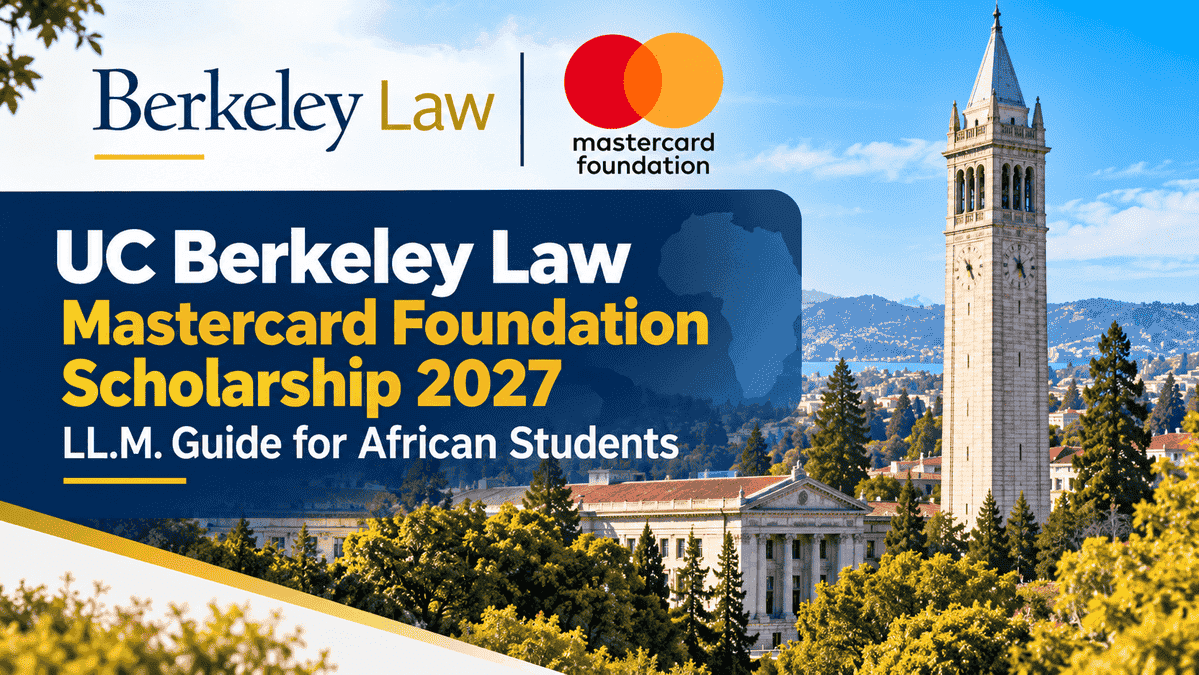
The UC Berkeley Law Mastercard Foundation Scholarship 2027 offers African applicants a fully funded route to the LL.M. Traditional Track at Berkeley Law.
There is an important distinction from the broader UC Berkeley Mastercard Foundation programme: this opportunity is tied specifically to Berkeley Law’s Traditional LL.M. You must first apply to Berkeley Law, after which eligible admitted students can enter the Mastercard Foundation scholarship consideration process.
For prospective applicants, the most useful questions are therefore not simply whether Berkeley offers the scholarship, but which LL.M. qualifies, what Berkeley Law requires, when to apply, what the funding covers, and how to position your application.
Who Is Eligible for the Berkeley Law Scholarship?
The Mastercard Foundation’s broader Berkeley eligibility requirements still apply. These include African citizenship, academic ability, leadership potential, significant barriers to higher education and a commitment to creating positive change.
However, satisfying those criteria does not replace Berkeley Law’s admission requirements.
You must also qualify for the LL.M. Traditional Track, which requires an appropriate first law degree and completion of Berkeley Law’s application requirements.
Think of eligibility as two connected questions:
- Do I meet the Mastercard Foundation’s eligibility criteria?
- Can I gain admission to the Berkeley Law LL.M. Traditional Track?
You need to satisfy both.
see our UC Berkeley Mastercard Foundation Scholars Program guide
Which Berkeley Law LL.M. Is Eligible?
This is the most important programme-specific distinction.
Berkeley Law offers both a Traditional LL.M. and an Executive LL.M., but the Mastercard Foundation opportunity is associated with the LL.M. Traditional Track.
The Traditional LL.M. is a full-time, nine-month programme conducted in residence at Berkeley.
Therefore, do not assume that applying to any Berkeley Law LL.M. automatically puts you into consideration for Mastercard Foundation funding.
If this scholarship is your intended funding route, select the Traditional LL.M.
What Does Berkeley Law Require?
Your scholarship strategy begins with a strong Berkeley Law application.
For the LL.M. Traditional Track, applicants should prepare the core admission materials, including:
- A qualifying first law degree
- Academic transcripts
- LSAC Credential Assembly Service report
- Personal statement
- CV or résumé
- Two recommendation letters
- English-language evidence or an approved waiver, where applicable
Start the LSAC process early
The LSAC component deserves particular attention from international applicants.
Do not leave your transcript and credential requirements until shortly before the Berkeley Law deadline. Documents may take time to obtain, process and assemble, and delays can affect the completeness of your application.
Starting early also gives you time to identify missing documentation and resolve problems before submission.
Berkeley Law does not specify a mandatory minimum number of years of professional experience for the Traditional LL.M. Instead of trying to reach an arbitrary number of years, focus on presenting a convincing academic and professional trajectory.
Berkeley Law Mastercard Foundation Deadline for 2027
For the 2027 intake, Berkeley Law lists:
| Date | Deadline |
|---|---|
| September 1, 2026 | LL.M. application opens |
| December 1, 2026 | Priority deadline |
| February 1, 2027 | Regular deadline |
Why December 1 matters
If you need Mastercard Foundation funding, December 1 should be your target date.
Berkeley Law gives applicants who submit a complete application by the priority deadline priority consideration for scholarships and an earlier admissions decision, with priority applicants receiving a decision by January 15.
February 1 remains the regular deadline, but waiting until February is not the strongest strategy for an applicant who depends on scholarship funding.
The practical distinction is:
February 1 is the regular LL.M. deadline. December 1 is the priority deadline you should target for scholarship consideration.
December 1 is not a separate Mastercard Foundation application deadline. It is the Berkeley Law deadline that matters to your position in the admissions and scholarship process.
How the Scholarship Process Works
Your first application is to Berkeley Law, not directly to the Mastercard Foundation.
The pathway is:
Apply to the Traditional LL.M. → Berkeley Law admission process → Berkeley Law nomination → Mastercard Foundation scholarship process
If Berkeley Law nominates you, you then proceed to the Foundation’s additional selection process.
This distinction matters because admission does not guarantee the scholarship.
Your application therefore needs to accomplish two things: first, demonstrate that you belong in the Berkeley Law LL.M.; second, give the law school a compelling reason to consider you for Mastercard Foundation nomination.
Being nominated also does not mean that the scholarship has already been awarded. Final scholarship selection remains a separate stage.
What Does the Berkeley Law Scholarship Cover?
The Berkeley Law Mastercard Foundation award goes beyond tuition.
If awarded, the Mastercard Foundation Scholars Program provides tuition support plus expenses such as:
- Student Health Insurance Plan (SHIP)
- Books
- Laptop
- Accommodation
- Flights
- Visa costs
Berkeley Law’s Advanced Degree Programs Office covers any remaining tuition balance as part of the overall funding arrangement.
For an international LL.M. applicant, that makes this substantially different from a scholarship that only reduces tuition while leaving the recipient to finance the major costs of studying in the United States.
However, applicants should still review the terms of their eventual award rather than assuming that every personal expense will automatically receive funding.
How to Make Your Application Stronger
The strongest approach is not to manufacture a dramatic leadership story.
Instead, show a credible connection between:
Your legal background → the problem you want to address → why Berkeley Law is the right next step.
Your experience might involve access to justice, human rights, legal research, public policy, community development, support for underserved groups or another area where legal training has helped you address a real problem.
The important thing is to demonstrate evidence, not simply describe yourself as passionate or committed.
For example, rather than saying:
“I am passionate about improving access to justice.”
Explain what you have actually done, what problem you encountered and what you learned from that experience.
Make your personal statement do more than repeat your CV
Your CV shows what you have done.
Your personal statement should explain why those experiences matter, what you want to accomplish and why an LL.M. is necessary for that next stage.
A strong application should make the progression easy to understand:
Past experience → current limitation or problem → need for advanced legal training → future impact.
That approach also prevents your personal statement from becoming a chronological repetition of your résumé.
Four Berkeley Law Mistakes to Avoid
1. Applying to the wrong LL.M. track
The Mastercard Foundation opportunity is associated with the Traditional LL.M. Do not assume that the Executive LL.M. qualifies.
2. Waiting until February
If scholarship funding is important to your plan, target December 1, 2026 rather than treating February 1 as your working deadline.
3. Confusing admission with scholarship selection
Berkeley Law admission and Mastercard Foundation selection are separate decisions.
Being admitted does not automatically mean that you will receive the scholarship, and nomination does not equal a final award.
4. Treating the scholarship as a substitute for a strong LL.M. application
The availability of comprehensive funding does not lower the standard of the Berkeley Law application.
Your academic record, personal statement, recommendations and supporting documents still need to make a convincing case for admission.
Berkeley Law Mastercard Foundation Scholarship 2027 Checklist
Before submitting your application, confirm that you have:
- ☐ A qualifying first law degree
- ☐ Selected the LL.M. Traditional Track
- ☐ Started your LSAC process early
- ☐ Prepared your academic transcripts
- ☐ Prepared your CV or résumé
- ☐ Identified two suitable recommenders
- ☐ Prepared a focused personal statement
- ☐ Confirmed your English-language requirement or waiver
- ☐ Reviewed the December 1, 2026 priority deadline
- ☐ Understood that Berkeley admission and scholarship selection are separate stages
Final Takeaway
The UC Berkeley Law Mastercard Foundation Scholarship 2027 should not be approached as another generic Berkeley scholarship application.
The opportunity is specifically tied to the LL.M. Traditional Track, so your first priority should be building a strong Berkeley Law application and submitting it by the December 1, 2026 priority deadline if you want scholarship consideration.
Start your LSAC process early, make your legal and professional trajectory clear, and use your personal statement to show why advanced legal training matters to the impact you want to create.
For a prospective African LL.M. applicant, the strategy is simple: choose the right programme, prepare early, target the priority deadline, and remember that Berkeley Law admission is the first stage—not the scholarship award itself.
For more details, visit the official scholarship resouces: Berkeley Law LL.M. application requirements